
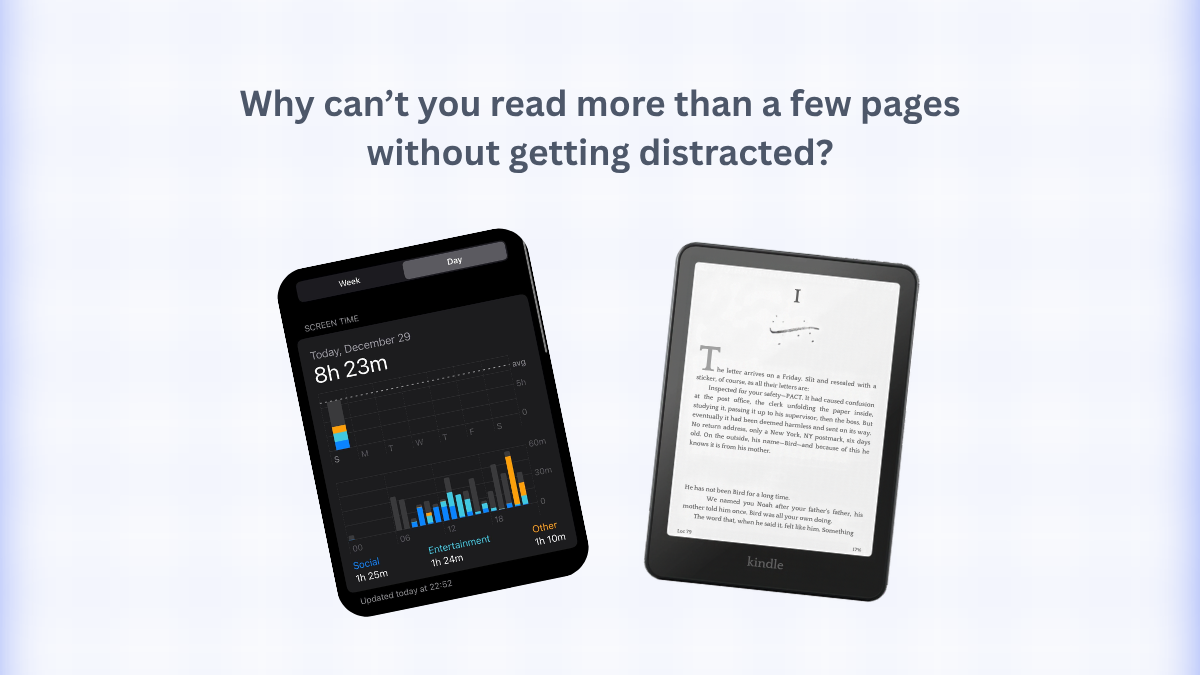
You used to read. There is a pile by the bed. You bought three of them this year, and one of them has been on page 40 since March. Every time you pick it up, you manage half a page and reach for your phone.
That is not proof that reading is gone. It is proof that the skill has gone stiff, and that the phone is winning the one moment that matters: the start of the session.
The short version
- Reading hasn't collapsed. In a Pew survey of 8,046 U.S. adults in October 2025, 75% had read at least part of a book in the past year. Most people read some. Few read a lot.
- The hard part is starting, not the middle of the book. A feed pays instantly. A book asks you to invest first.
- Make starting cheap: a fixed time, ten pages, and a book you actually like. Charge the phone in another room.
- When you still reach mid-paragraph: catch that urge with EMBO, then come back for one more page.
Reading is rusty, not broken
Long reading is a set of habits: holding a thread across pages, sitting through a slow chapter, and remembering tomorrow where you left off. You built those over years. If you have not used them, they stiffen the way any unused skill does.
The pile by the bed is also not evidence that nobody reads. Pew Research Center surveyed 8,046 U.S. adults from 6–16 October 2025. 75% had read all or part of at least one book in the past 12 months. 25% had read none. Among readers, the most common pattern is a handful of books, not a book a week: about 8% read one, 19% read two or three, and 10% read four or five.
If your honest number is a few books a year, you are in a large group. The goal is not to become someone else. It is to make the next ten pages happen.
Print is still the format most people use. In the same survey, 64% had read a print book, 31% an e-book, and 26% an audiobook. An audiobook counts if that is how you actually finish things. The problem this article is about is the one where a page loses to a feed.
Why the first page is the hardest
A book asks you to pay before it pays you back. The first twenty pages are mostly cost: names you do not know, a world you have no stake in yet. Everything else within reach pays immediately. A notification, a short video, a headline.
That is why the fight is almost never in the middle of a good chapter. It is at two moments:
1. The start of a session. You sit down, and the phone is closer than the bookmark.
2. The start of a book. Page 40 has been page 40 for months because this particular book is not earning the effort.
You only have to win those two moments. You do not have to win the whole evening.
Three things make them easier:
A fixed time, not a big goal. The twenty minutes before sleep, the first coffee, the train. A slot you do not have to invent beats an intention you have to summon.
A small number. Ten pages. If you read more, good. The number exists to make starting cheap. Ten pages a day, most days, is on the order of a book a month, depending on length. That is more than a resolution you keep postponing.
A book you like. Not the one you think you should finish. Putting a book down is a reading skill. If page 40 has not moved since March, the book is the problem.
The phone between paragraphs
You cannot hold a thread while you check your phone between paragraphs. The practical question is where the phone is when you sit down.
Charge it in another room, and put the book where the phone was. That swap does more than a reading app, because it changes what is within reach at the moment you decide.
Evening reading overlaps with sleep. A 2025 study in Frontiers in Psychiatry of 45,202 Norwegian students aged 18–28 found that each extra hour of screen use after going to bed went with 59% higher odds of insomnia symptoms and about 24 minutes less sleep. The link did not depend on whether the screen was social media or something else. The researchers are clear that this is a correlation: people who sleep badly may also reach for a phone more. Either way, the phone does not belong in the spot you are trying to read.
The harder case is the reach that happens anyway, phone across the room or not. You feel it in the middle of a paragraph. That is the same moment short-form feeds are built for: a reward before you have decided to leave.
A 2023 PNAS study followed 280 people who were interrupted as they tried to open chosen apps. They dropped 36% of those openings. Over six weeks, actual openings fell by 57%. The useful part was a real chance to not open the app. If brainrot is the fog after a long scroll, this is the smaller version: one reach that knocks you out of a page.
Catch that reach with EMBO
EMBO does not lock your apps until you finish a chapter, and it does not turn reading into a points system. It is for the impulse in the middle of the page.
1. Put the book in the phone's old spot. Leave the phone charging somewhere else if you can.
2. In the EMBO app, flag the apps you open when a paragraph gets slow.
3. If you still reach for one, a shield redirects you to your EMBO device instead of the feed.
4. Hold EMBO. Gentle pulses at a heartbeat-like 1–2 Hz rhythm target the median nerve in your palm, which has been linked to calming parasympathetic activity. The urge usually fades in a few minutes.
5. Then read one more page. One, not ten. The point is to return, not to punish yourself.
If you still want the app after that, you can open it. Now it is a decision, and the bookmark is still where you left it. See how EMBO works.
A four-week plan that stays small
What you are training is not speed. It is the ordinary feeling of staying with one thing for half an hour. That is also what makes a film, a conversation, or a piece of work feel less like effort.
| Week | Do this |
|---|---|
| 1 | Ten pages a day, same time. Phone in another room. Any book. Put it down if it is not working. |
| 2 | Same. When you feel the reach, hold EMBO, then read one more page. |
| 3 | Add a second slot on one day: a weekend morning, or the train. |
| 4 | Keep going from today if you missed days. Do not "make up" pages. A streak that survives a miss is the one that lasts. |
We recommend about 10 days of consistent EMBO use for the medium-term effect on the urge itself. Results vary from person to person. Judge the month by whether page 40 finally moved, not by whether every day was perfect.
The bottom line
You have not lost the ability to read. The skill is stiff, the first page is expensive, and the phone is winning the start of the session. Fix the setup: a fixed time, ten pages, a book you like, and the phone out of reach. Then give the mid-page urge somewhere to go. That is what EMBO is for.
Fix the Brainrot and Regain your Focus
EMBO helps you ride out the urge to grab your phone, so focus comes back as a habit rather than a fight. It's a one-time purchase with the app included and no subscription.
Frequently Asked Questions:
-
A book asks you to hold attention on one thing, with the payoff later. A feed pays immediately. If you have been living on the second, the first feels rusty. It comes back with short, repeated practice.
-
Fewer than you think. Ten pages at a fixed time beats a chapter you keep postponing. If you read more, keep going. The number is there so starting stays cheap.
-
It can, if you actually finish pages. For most people who "can't read anymore," the phone is also the distraction. A paper book, or an e-reader with nothing else on it, removes that fight.
-
It removes the easiest exit. You still need a small plan: when you read, how little you require of yourself, and what you do when the urge hits mid-paragraph.
Sources
Pew Research Center (2026), Americans still opt for print books. Survey of 8,046 U.S. adults, 6–16 October 2025.
Hjetland et al. (2025), How and when screens are used, Frontiers in Psychiatry
Grüning, Riedel & Lorenz-Spreen (2023), Directing smartphone use through the self-nudge app one sec, PNAS
AUTHOR
Alonso Arribas
Founder and CEO, EMBO
Alonso is the founder of EMBO. He holds a Bachelor in Biomedical Engineering from University of Maryland and University Carlos III, and has actively taken part in the end-to-end design and production of EMBO, both the physical device and the app.
