
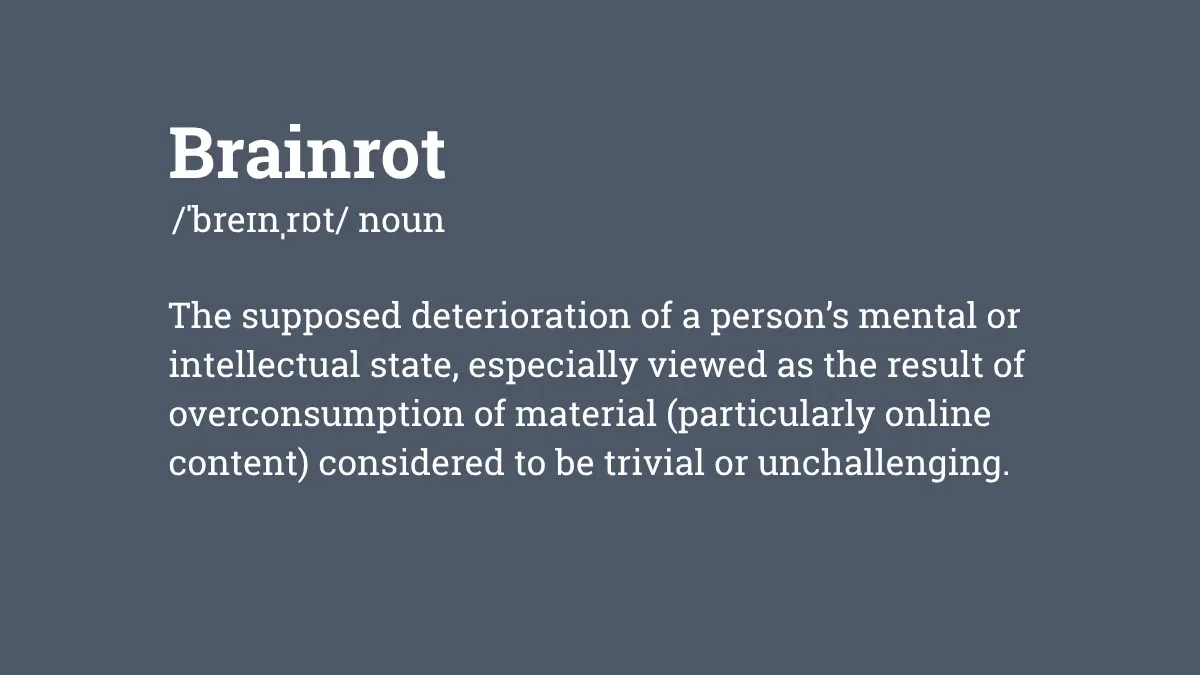
"Brainrot" is the word people reach for when they've scrolled so long that a book feels like work. Oxford named brain rot its Word of the Year for 2024 after use of the term rose by about 230% in a year. The research behind the feeling is real enough to take seriously.
This guide separates the slang from the studies, then covers what actually helps when the fog sets in.
Too long, don't want to read:
- Brainrot is slang, not a diagnosis. Oxford describes a supposed mental dulling from too much trivial online content, and the content itself.
- A 2025 meta-analysis of 71 studies (about 98,000 people) linked heavier short-form video use with poorer attention and impulse control. That is a strong correlation.
- Everyday signs: opening an app on autopilot, abandoning long content halfway through, feeling flat after a long scroll.
- What helps: replace the scroll with something specific, practice longer attention, and catch the urge at the moment you reach for the phone. That's where EMBO comes in.
What people mean by brainrot
People use the word in two ways:
A state. "I have brainrot" means: I have scrolled so much that I cannot think straight.
A kind of content. "This is brainrot" means: this clip is nonsense, and I am watching it anyway.
Oxford's 2024 definition covers both: the supposed decline of a person's mental state from consuming too much trivial material, mostly online, and the material itself. Note the word supposed. Oxford describes how people use the term. It does not claim the decline is a medical fact.
The first recorded use of "brain-rot," according to Oxford, goes back to Henry David Thoreau's Walden in 1854. The modern meaning took off on social media, especially around short-form video.
Brainrot is also different from doomscrolling. Doomscrolling is the behaviour: scrolling on and on, often through bad news. Brainrot is the supposed result, and a label for the content.
What the research actually says
The serious question behind the meme is: does a lot of short, fast content go together with worse thinking?
The best summary so far is a 2025 analysis in Psychological Bulletin by Nguyen and colleagues. It pooled 71 studies with about 98,299 participants. Heavier short-form video use was linked with:
| Outcome | Association with heavier short-video use |
|---|---|
| Cognition overall | Moderate negative (r ≈ −.34) |
| Attention | Negative (r ≈ −.38) |
| Inhibitory control (stopping an impulse) | Negative (r ≈ −.41) |
| Mental health overall | Weak negative (r ≈ −.21) |
Three limits matter before you draw conclusions:
1. These are correlations. Heavy use and poorer attention appear together. The studies do not prove which causes which. People who already find it hard to focus may be drawn to short videos.
2. Much of the data is about compulsive use. Many studies measured "addictive" or problematic use, not simply minutes watched.
3. Nothing here shows physical damage. "Rot" is a metaphor. There is no evidence that short videos decay brain tissue.
A fair reading: short videos are not proven to harm your brain. A compulsive scrolling habit and a weak attention span are often found in the same person.
Signs people mean when they say "brainrot"
These are everyday descriptions, not symptoms of an illness:
You open an app without having decided to.
A film, a book or a long article feels like work, and you reach for your phone halfway through.
You feel foggy or flat after a long scroll.
An hour is gone and you cannot say what you watched.
If concentration, memory or mood problems last, or affect work and relationships, do not self-diagnose with a meme. Sleep, stress and health all affect attention. A doctor can help you sort out which it is.
Why deleting the app often isn't enough
Most advice stops at "use your phone less" or "delete TikTok." That helps for a week. Then the gap gets filled by another feed, or by the browser version of the same app.
Three reasons the fog comes back:
1. The design has no stopping point. Short-form feeds are built to load the next clip before you decide to leave.
2. The urge arrives before the decision. By the time you notice you've opened the app, you're already in it.
3. Willpower is weakest when the content is easiest. Late at night, in a queue, or between tasks, the path of least resistance is the scroll.
Research on interrupting that moment points in a useful direction. A 2023 PNAS study of 280 people found that interrupting them as they tried to open a target app led them to dismiss 36% of those openings. Over six weeks, actual openings fell by 57%. The most effective part was offering a real option to not open the app.
In other words: catch the reach, not the scroll.
What helps, in practice
1. Decide what replaces the scroll
Removing an app leaves a gap. Choose the replacement first: a book on the nightstand, a walk without the phone, a short workout, or a message to a friend. Our concept for those in-between moments is Solo Moments, the commute, the queue, the few minutes before sleep.
2. Practice longer attention on purpose
Long reading, a walk without headphones, and single-tasking are all practice. They rebuild the muscle that short clips wear down. Start with ten focused minutes, not an hour.
3. Catch the urge with EMBO
EMBO is built for the moment before the feed opens. It's a small handheld device that delivers gentle pulses to your palm, paired with an app that catches you as you reach for the apps that drain you.
1. In the EMBO app, flag the apps that leave you foggy (TikTok, Reels, Shorts, and so on).
2. When you open one out of habit, a shield redirects you to your EMBO device.
3. Hold EMBO. Its gentle pulses, at a heartbeat-like 1–2 Hz rhythm, target the median nerve in your palm. Stimulating that nerve has been linked to calming parasympathetic activity, so the urge has a chance to fade instead of being fought.
4. If you still want the app afterward, you can. Now it's a decision, not a reflex.
EMBO doesn't block your phone or claim to "cure" brainrot. It gives you a physical pause at the moment the habit usually wins. We recommend about 10 days of consistent use for the medium-term effect, though results vary from person to person. Read the science behind EMBO.
The bottom line
Brainrot is a useful word for a real feeling, and a bad word for a medical claim. The research links heavy short-form video use with poorer attention and impulse control, without proving that your brain is decaying. What you can change is the behaviour: fewer autopilot opens, more activities that hold your attention, and a pause at the moment you reach for the phone. That pause is what EMBO is for.
Fix the Brainrot and Regain your Focus
EMBO helps you ride out the urge to grab your phone, so focus comes back as a habit rather than a fight. It's a one-time purchase with the app included and no subscription.
Frequently Asked Questions:
-
No. Brainrot is slang, not a diagnosis. It describes a feeling: being mentally dulled after a lot of low-effort online content. If concentration problems last or affect your work, school or mood, talk to a doctor.
-
Oxford traces an early use to Thoreau's Walden (1854) and named brain rot its Word of the Year for 2024 after a sharp rise in use.
-
Research shows a link, not proof of cause. The 2025 Psychological Bulletin meta-analysis found that heavier short-form video use goes together with poorer attention and impulse control. It cannot say which one comes first.
-
There is no clinical recovery plan, because it is not a clinical condition. What you can change is the behaviour: less compulsive scrolling, more activities that hold your attention, and a pause at the moment you reach for the phone.
-
Doomscrolling is the behaviour. Brainrot is the supposed result, and also a name for the content itself.
Sources
Oxford University Press, Word of the Year 2024 (as reported in December 2024 coverage)
Nguyen et al. (2025), Feeds, feelings, and focus, Psychological Bulletin, 151(9), 1125–1146
Grüning, Riedel & Lorenz-Spreen (2023), Directing smartphone use through the self-nudge app one sec, PNAS
Unrot, What is brainrot?
AUTHOR
Alonso Arribas
Founder and CEO, EMBO
Alonso is the founder of EMBO. He holds a Bachelor in Biomedical Engineering from University of Maryland and University Carlos III, and has actively taken part in the end-to-end design and production of EMBO, both the physical device and the app.
